Every time tragedy strikes: a shooting, act of violence, a suicide, a sex assault, a fraud case, a scandal, the aftermath sounds the same. Investigators find pre-incident warning signs that existed. Resources that could have intervened existed. And yet the tragedy still occurred.
This isn’t bad luck. It isn’t a one-off failure. It’s a pattern and a problem that has existed for decades.
I call it the Gapidemic.
What Is the Gapidemic?
The Gapidemic is the unnamed, unsolved, underlying problems that exist in nearly every organization and every community, regardless of size or sector. For decades, it was assumed training, a new policy, and meetings could fix it. They haven’t and they can’t. A different solution is needed to fix the gaps:
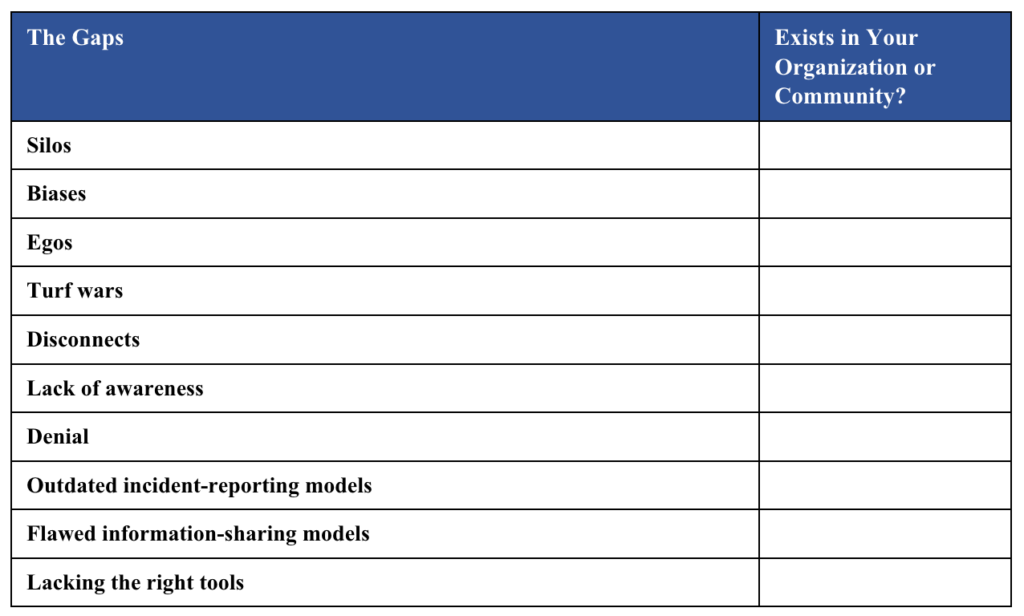
None of these gaps (and others) are new. What’s new is naming the bigger and real problem instead of treating each failure as an isolated surprise.
You Can’t Prevent More Incidents Until You Fix the Gapidemic
Let me repeat that… you can’t prevent more incidents until you fix the Gapidemic. These same gaps have shown up repeatedly for decades in nearly every type of incident and tragedy:
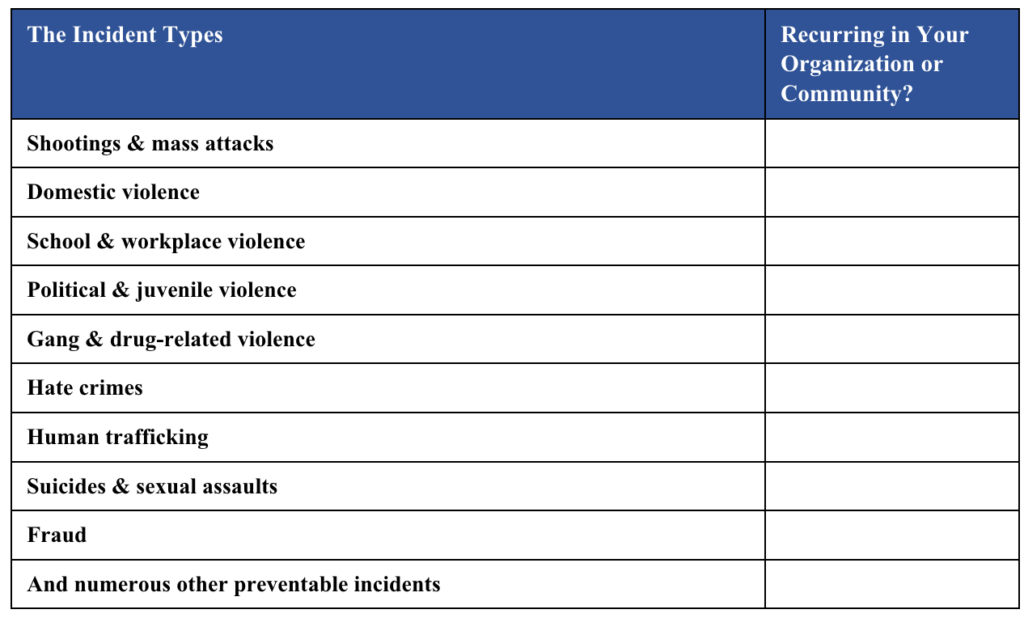
Different organizations, different communities, different circumstances, the same underlying failure to connect warning signs to the right resources in time to take the right actions. No incident type on this list is exempt from it.
The Evidence Has Existed for Decades
The Gapidemic is why investigators concluded the country “failed to connect the dots” before September 11, 2001.
It’s also why the U.S. Secret Service’s National Threat Assessment Center (NTAC), in its landmark study of 173 mass attacks in public spaces involving 180 attackers, found this: “All of the 180 attackers either 1) elicited concern from others, 2) shared one or more concerning communications, 3) demonstrated behavioral changes, or 4) engaged in overt planning behaviors prior to their attacks.” Not most. All of them. And still, none of the attacks were prevented, despite the fact that pre-incident warning signs and the resources to intervene both existed.
That’s the Gapidemic: the information was there and the people who could have acted were there. The connections between them were never made, because of all the gaps. This is the Gapidemic.
These Costs Hurt Budgets and Are Not Sustainable
The Gapidemic doesn’t just cost lives and trust. It costs money, a lot of it, and those costs land heavy on budgets of organizations and communities… imagine what those millions of dollars could have been utilized for?
| Incident Type | Typical Cost of Response | Savings if Prevented |
| Homicide | $1M – $20M+ | $10M+ |
| Mass Shooting (fatalities) | $50M – $800M+ | $400M+ |
| School Shooting | $1M – $100M+ | $50M+ |
| Suicide | $1M – $2.5M | $1.75M+ |
| LE-Involved Shooting (fatalities) | $2M – $20M+ | $11M+ |
| In-Custody Death | $500K – $15M+ | $7.75M+ |
| Domestic Violence (non-fatal) | $50K – $500K+ | $275K+ |
| Cyber/Ransomware Incident | $500K – $10M+ | $5M+ |
When one incident is prevented, the avoided costs typically include response, recovery, investigations, healthcare, mental health treatment, judicial proceedings, incarceration, lawsuits, settlements, fines, reputational damage, lost business, and, for those involved, a lifetime of regret that has no dollar figure at all.
Now ask yourself a harder question. Isn’t one preventable tragedy too many?
If your organization or community has experienced more than one incident or tragedy where pre-incident indicators existed and your resources still failed to prevent it, the Gapidemic already exists, and tragedies and lawsuits will continue until you fix your Gapidemic.
Named a Decade Ago, Still Ignored
This is not a new observation dressed up in a new name. In 2014, I wrote a multi-part blog series naming this exact pattern the Prevention Gapidemic, built on my research and evidence from post-tragedy reports showing pre-incident indicators existed, incident reports were filed, and organizations still failed to connect the dots in time. The 2014 blog series asked a simple question that is just as true today: if old approaches such as security products, awareness campaigns, and policies were the solution, why do the same preventable incidents keep happening?
Another decade later, the answer is still clear. Those approaches were never the solution, because they were never aimed at the actual Gapidemic problem. Schools, higher education, workplaces, and communities have spent years blaming government, blaming funding, and blaming politicians. But you cannot fix school shootings, domestic violence, workplace violence, or any other incident type until you fix the Gapidemic first.
Tragedy. Outrage. Transformation. Or Tragedy. Outrage. Tragedy.
For decades, the “Tragedy. Outrage. Tragedy.” pattern has repeated across government, schools, higher education, and agencies of every kind: A tragedy. A press conference. A promise to do better. And then the next tragedy, because the underlying Gapidemic was never fixed.
There is another path: “Tragedy. Outrage. Transformation.” It requires naming the real problem (Gapidemic) instead of blaming government, funding, or politicians, and it requires fixing the gaps instead of continuing to respond to the next tragedy, the next outrage, the next headline, the next lawsuit, and the next tragedy…
The only question left: is your organization going to be part of the repeated pattern, or the new path?
The Tragedies Will Continue, Until You Fix the Gapidemic
The Gapidemic has gone unsolved for decades because it has never been named, diagnosed, or treated as a single condition. It will keep repeating in different locations, organizations, and communities until leaders of organizations and communities stop treating each incident as an isolated failure and start fixing their Gapidemic.
The fix is the First Preventers Framework, built from more than 25+ years of research and asking the right questions about hundreds of recurring gaps. It has been field-tested for 10+ years. It gives organizations and communities the framework of tools and strategies to fix their gaps before the next incident, not after.
Comments are closed, but trackbacks and pingbacks are open.